Folding a few letters by hand is easy. Folding hundreds of invoices, statements, notices or marketing letters is a very different job.
For businesses that regularly prepare large volumes of documents for mailing, manual folding can consume hours of staff time every month. A paper folding machine automates this repetitive task, producing consistently folded documents in a fraction of the time.
But when does buying or leasing a folding machine actually make sense for a business?
What Is a Paper Folding Machine?
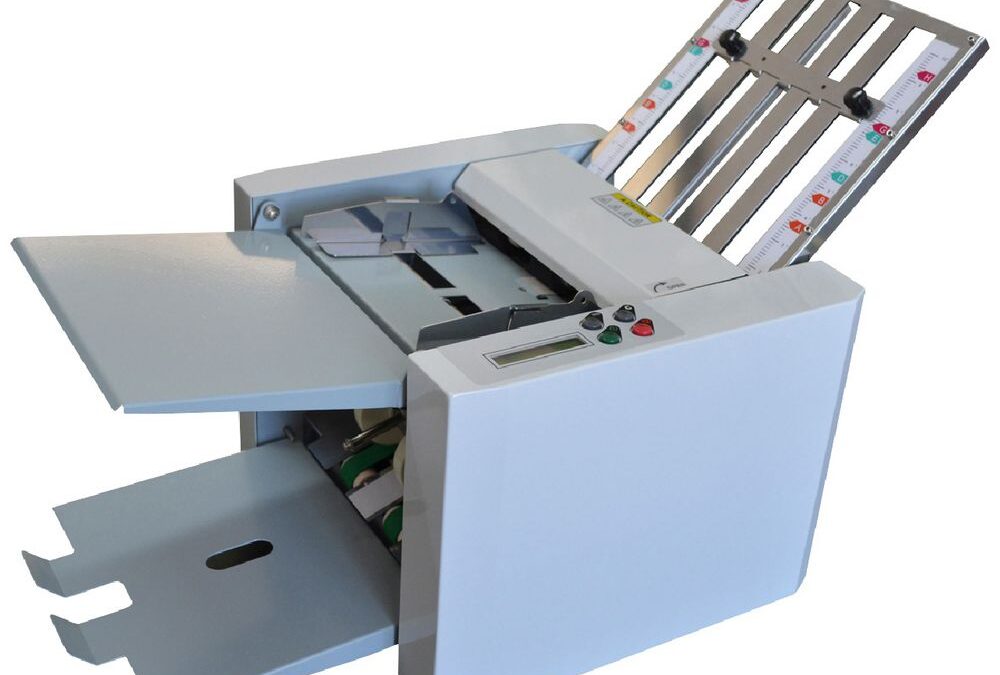
A folding machine automatically feeds sheets of paper through a series of rollers and folding plates to create a predetermined fold.
Instead of an employee manually folding each document, large quantities of paper can be processed automatically.
Depending on the model, folding machines can accommodate different paper sizes, thicknesses, folding styles and processing volumes.
What Can Folding Machines Be Used For?
Businesses use automatic folding machines to prepare many different types of documents, including:
- Invoices
- Customer statements
- Business correspondence
- Notices
- Marketing letters
- Direct mail campaigns
- Brochures
- Information sheets
- Newsletters
They can be useful anywhere that the same folding task needs to be repeated regularly.
The Hidden Cost of Folding Documents by Hand
Manual folding doesn’t normally appear as a separate expense on a company’s accounts.
The cost is hidden in staff time.
Imagine an employee needs to prepare 500 letters.
Each letter has to be picked up, aligned, folded and placed into the next stage of the mailing process. Even if each document takes only several seconds, repeating the process hundreds of times can consume a significant portion of the working day.
Repeat that every week or every month and a seemingly minor administrative task can become a substantial ongoing labour cost.
A folding machine allows much of this repetitive work to happen automatically.
Consistency Matters Too
Speed isn’t the only advantage.
Hand-folded documents inevitably vary slightly from one to another. This may not matter when preparing five letters, but inconsistencies become more noticeable when processing hundreds or thousands.
An automatic folding machine produces a consistent fold across the entire batch.
This can create a more professional presentation while also making documents easier to process during subsequent mailing operations.
Different Types of Paper Folds
Modern folding machines can support a variety of common folding configurations depending on the model.
These may include:
Letter Fold
Often called a C-fold, the paper is divided into three sections that fold inward. This is commonly used for business correspondence placed into standard envelopes.
Z-Fold
The paper folds backwards and forwards to create a Z shape. This is frequently used for statements, notices and marketing material.
Half Fold
The document is folded once through the centre.
Double Parallel Fold
The paper is folded in half and then folded again, allowing larger documents to be reduced to a compact size.
The appropriate machine depends partly on the documents your organisation processes and the folds you regularly require.
Who Uses Folding Machines?
Folding equipment isn’t limited to large mailrooms.
It can be useful across many industries and organisations, including:
- Accounting practices
- Financial services businesses
- Government departments
- Schools and educational organisations
- Healthcare providers
- Legal practices
- Charities and associations
- Marketing businesses
- Utilities
- Councils
- Corporate offices
The important factor isn’t necessarily the size of the organisation. It is how much repetitive document folding the organisation performs.
When Does a Folding Machine Make Sense?
There isn’t a single number of letters at which every business suddenly needs a folding machine.
Instead, consider how much staff time is currently being spent manually folding documents.
If an employee occasionally folds 20 letters, automation may provide little benefit.
If employees regularly spend hours preparing hundreds or thousands of documents, the calculation changes considerably.
Ask a simple question:
Could the employee doing this task be doing something more valuable with their time?
If the answer is yes, automating the folding process may be worth investigating.
Choosing the Right Folding Machine
Not every folding machine is designed for the same workload.
Before choosing a machine, consider:
- Average number of documents processed
- Peak mailing volumes
- Paper sizes used
- Paper weights
- Required fold types
- Frequency of use
- Available office space
- Whether documents require additional mail processing
A small office processing occasional batches has very different requirements from a dedicated mailroom processing thousands of documents.
Choosing equipment suited to the actual workload can provide better value than simply selecting the fastest or largest machine available.
Turn a Repetitive Job Into an Automated Process
Folding documents is a simple task, but that doesn’t mean employees should spend hours doing it manually.
As mailing volumes increase, repetitive document preparation can become an unnecessary drain on staff time.
A paper folding machine can turn hundreds of individual manual actions into an automated process, helping businesses prepare documents faster and with greater consistency.
If your organisation regularly processes invoices, statements, correspondence, brochures or direct mail, it may be worth calculating how many staff hours are currently being spent simply folding paper.