When an office sends letters, invoices or notices in batches, folding the pages can take longer than expected. A folding machine can remove that manual step. But if staff still spend hours putting the pages into envelopes, a folding and inserting machine may be the better fit.
The choice comes down to what happens to the paper after it is folded.
What does a folding machine do?
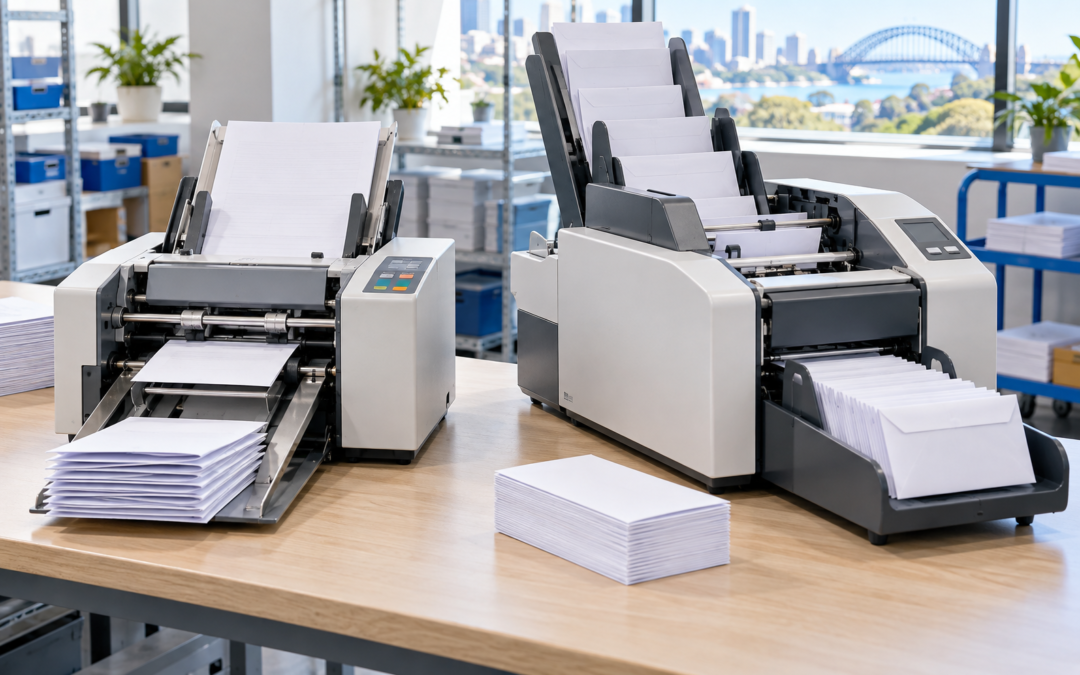
A paper folding machine takes sheets from a feeder, folds them and stacks the finished documents. It can help when your office regularly prepares brochures, leaflets, statements or letters and needs consistent folds across a batch.
It is also useful when the folded documents have different destinations: some may go into envelopes, while others are handed out or placed in packages.
FP Mail offers folding machines for different workloads. Its EP-42F handles A3 and A4 sheets, the FP-RD 298 is designed to cope with glossy paper and occasional high volumes, and the Superfax 215 is intended for regular, larger folding runs.
What does a folding and inserting machine add?
A folding and inserting machine continues the process. After folding the pages, it places them into envelopes and seals them.
That extra step matters if envelope preparation is where your team spends most of its time. If staff fold documents quickly but then spend the rest of the afternoon inserting and sealing them by hand, a folding machine alone may leave the main bottleneck in place.
Look at a typical mailing run
Before choosing equipment, follow one batch from the printer to the outgoing mail tray. Note:
- How many sheets you prepare at a time
- The paper sizes and finishes you use
- Whether every folded document goes into an envelope
- How many pages need to be grouped together
- How much time staff spend folding, inserting and sealing
These details will tell you more than monthly paper volume alone. A business preparing brochures for distribution has a different workflow from one sending hundreds of addressed customer letters.
Match the machine to the task
Choose a folding machine when folding is the main task or when the finished sheets will be used in several ways. Consider a folding and inserting machine when your routine involves preparing large batches of envelopes and you want to automate more of that process.
If you are unsure which setup suits your office, show FP Mail an example of the documents and envelopes you use. Their team can help you compare equipment against your actual mailing workflow.
For advice on folding machines and folding and inserting machines, contact FP Mail Australia on 1300 943 274.